
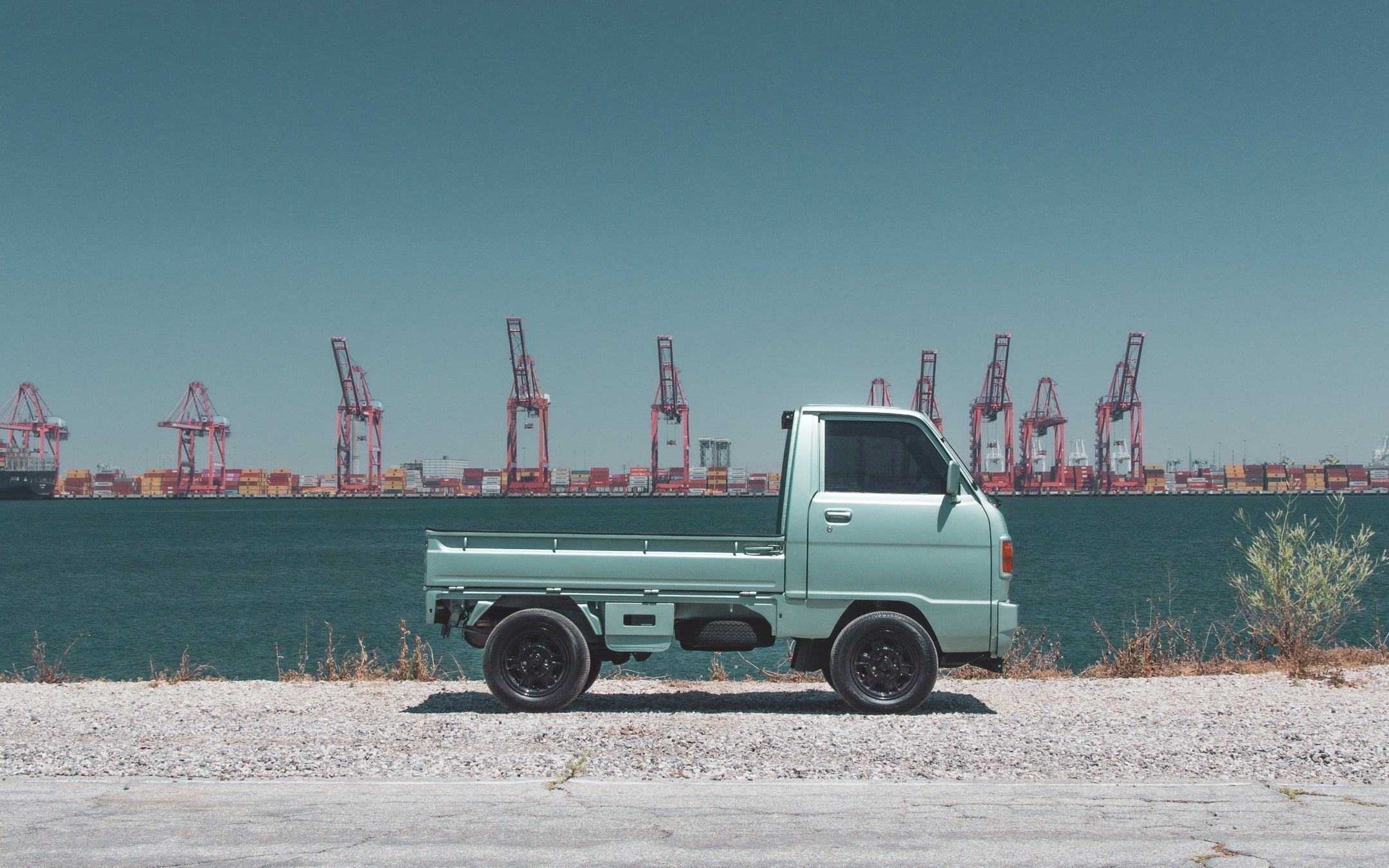
Most stock kei trucks top out between 50 and 65 mph, but certain models can reach or exceed 75 mph.
How Fast Can a Kei Truck Go?
Most stock kei truck top speeds range from 50 to 65 mph, but certain models are capable of reaching or exceeding 75 mph.
When discussing kei truck top speed, it’s important to distinguish mechanical capability from state-level restrictions.
A supercharged 2000 Subaru Sambar (TT2) might be capable of reaching 70 mph. However, states like Florida restrict mini truck road use to streets with posted limits of 35 mph or less. Check your state’s road laws before conducting independent top speed testing.

Kei Truck Top Speed by Manufacturer and Generation
Realistic top speed for selected models. Scroll sideways on small screens.
| Model | Engine | Realistic top speed |
|---|---|---|
| Suzuki Carry DC51T (1993) | 657cc F6A | 65 mph |
| Suzuki Carry DA62T (2001) | 658cc K6A | 65 mph |
| Honda Acty (HA3/HA4) | 656cc E07A | 65–70 mphDrivetrain dependent |
| Daihatsu Hijet S100P (1995) | 659cc EF | 70 mph |
| Subaru Sambar TT2 (1999) | 658cc EN07F (supercharged) | 75 mph |
The top speed figures above cover selected Oiwa-supported chassis, not every generation of each kei truck. Furthermore, the speeds assume best-case, flat-ground conditions.
Key Takeaways
- Top speed figures assume ideal conditions (e.g., paved surfaces, clear weather). Factors like hills, headwinds, or a loaded bed prevent a kei truck from fulfilling its top speed potential.
- Most popular kei truck models imported into the U.S. have top speeds ranging from 50 to 65 mph.
- Select stock kei trucks can reach or exceed 70 mph.
- Larger tires and a five-speed transmission don’t automatically mean higher top speed; engine power and actual gear ratios determine the result.
- Check your state’s road-use rules before independently testing a kei truck’s top speed: a mini truck capable of 70 mph might be restricted to roads posted at lower speed limits.
What Affects a Kei Truck’s Top Speed?
Factors that can influence a kei truck’s top speed include:
- Mechanical condition (e.g., engine and output)
- Transmission and gearing
- Drivetrain
- Tires
- Weight, load, and aerodynamic drag
- Road/driving conditions
How Does Mechanical Condition Impact Kei Truck Top Speed?
A kei truck’s top speed means that its engine is operating at maximum capacity with no reserve power. If a kei truck has a mechanical problem like low compression, inaccurate air-to-fuel ratios, or ignition inefficiency, it can’t produce its factory-rated horsepower to reach top speed.
Other common mechanical problems impacting kei truck top speed are:
- Worn wheel bearings
- Dragging brake calipers
- Old transmission and/or differential fluids
- Exhaust restriction
- Vacuum leaks
Routine maintenance and timely repairs are key to achieving a kei truck’s top speed.
How Does a Kei Truck’s Transmission and Gearing Affect Top Speed?
Transmission and final-drive ratios affect a kei truck’s top speed by determining how engine RPM translates into road speed. Taller gearing (e.g., 5-speed vs. 4-speed) can raise an RPM-limited kei truck’s top speed, but its small engine may struggle to pull the taller ratio, reducing top speed instead.
Additionally, some kei trucks built for trades like farm work, such as the 2004 Daihatsu Hijet Truck Agriculture Special (S210P, 4WD), might have shorter lower gears and final-drive ratios for torque, resulting in lower top speeds despite having a five-speed transmission.
In other words, don’t assume a kei truck with taller gearing will automatically have a higher top speed.
How Do Other Factors Affect Kei Truck Top Speed?
- DrivetrainFour-wheel drive systems may add extra weight and drivetrain friction, which can marginally reduce top speed compared to two-wheel drive systems.
- TiresGenerally, taller tires cover more ground per turn, which can lower rpm (revolutions per minute) and increase a vehicle’s top speed. However, kei trucks’ modest engines may lack the torque to turn heavier, taller tires (e.g., off-road/all-terrain), which can lower top speed.
- Weight, load, and aerodynamic dragHeavier curb and load (payload) weights force a kei truck’s engine to work harder to propel the vehicle, and some models have exterior configurations increasing aerodynamic drag. For instance, a lift kit can create more high-velocity drag under the vehicle, reducing top speed.
- Road conditionsInclines, headwinds, elevation, and driving on unpaved surfaces can make it harder to reach a kei truck’s top speed. A newer mid-size sedan, for example, has more engine power reserve to compensate for these factors, unlike a kei truck.
Can You Increase a Kei Truck’s Top Speed?
Common ways drivers attempt to increase a kei truck’s top speed include:
- Engine upgrades
- Installing a high-flow exhaust system
- High-gear differential swap
- Tuning the carburetor or electronic fuel injection
Before making any modifications, consult Oiwa Garage about the right way to alter your kei truck.
What Is a Realistic Cruising Speed?
Realistic kei truck cruising speeds range from 45 to 58 mph, with 52 mph being the average for popular stock models from the 1990s and early 2000s.
Top speed capabilities should be distinguished from cruising.
Still, like top speed, hills, cargo, and rough road conditions affect cruising speed because they force kei truck engines to work harder.
Below are a handful of owner-reported cruising speeds for popular 1990s and early-2000s kei trucks.
Owner-reported cruising ranges. Scroll sideways on small screens.
| Model | Engine | Cruising range |
|---|---|---|
| Honda Acty | 656cc E07A | 45–55 mph |
| Suzuki Carry | 657cc F6A | 50–55 mph |
| Daihatsu Hijet | 659cc EF | 50–55 mph |
| Subaru Sambar | 658cc EN07 | 50–55 mphNaturally aspirated60+ mphSupercharged |
| Mitsubishi Minicab | 657cc 3G83 | 50–58 mph |
Can Kei Trucks Legally Drive on U.S. Highways?
States control highway eligibility laws for kei trucks. For example, Texas, Vermont, and Alaska are a few states that permit kei trucks on highways (outside interstates).
In comparison, states such as New York and Maryland outlaw kei trucks on public roads.
Refer to your state’s DMV (or equivalent agency) for eligibility guidance.
Keep your kei truck running at full strength. Shop parts for your model:
Contact our team: call or text 562-661-8862, or email support@oiwagarage.co.