
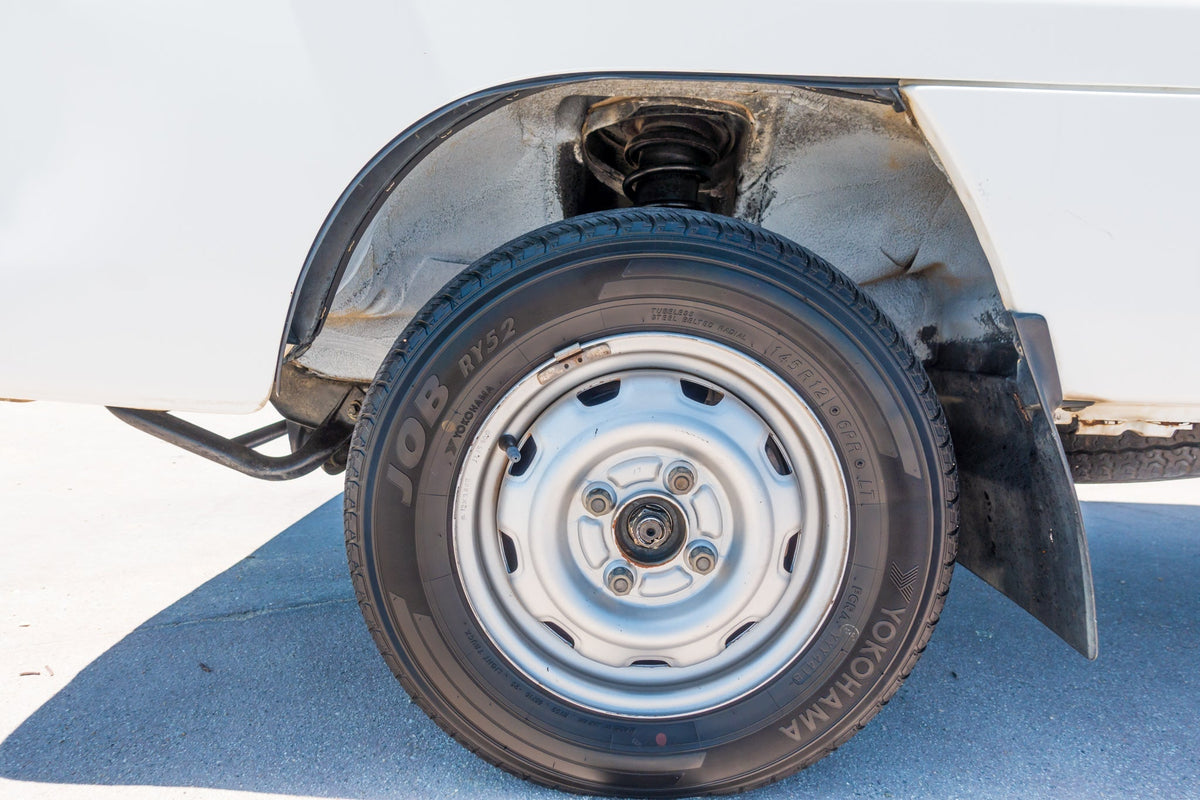
Quick Jump Index:
- Quick Reference: Fitment Specs Summary Table
- Why Kei Truck Wheel Fitment Varies by Generation
- Honda Acty HA3/HA4 Wheel & Tire Fitment
- Suzuki Carry DD51T Wheel & Tire Fitment
- Daihatsu Hijet S100P/S110P Wheel & Tire Fitment
- Pre-Purchase Wheel & Tire Checklist
- Pros & Cons of Upsizing Kei Truck Wheels
- Frequently Asked Questions
Quick Answer: What fits my Japanese kei truck?
Japanese JDM kei trucks do not use a single universal wheel size. Pitch Circle Diameter (PCD) varies between 4x100, 4x114.3, and 4x110 across the Acty, Carry, and Hijet models detailed in this general guide. Always verify your specific chassis code, center bore diameter, and wheel offset before purchasing aftermarket wheels to prevent severe tire rubbing against strut housings or fender arches.
Kei Truck Factory Wheel Specs Comparison Table
Use this quick reference guide to verify documented factory bolt patterns, center bore sizes, standard wheel offsets, and tire configurations for these popular Honda Acty, Suzuki Carry, and Daihatsu Hijet models.
| Make & Model | Chassis Code | Production Years | Bolt Pattern (PCD) | Center Bore | Factory Offset | Documented Factory Fitments |
|---|---|---|---|---|---|---|
| Honda Acty | HA3 / HA4 | 1990–1994 | 4x100 mm | 56.1 mm | ET40 (40 mm) | 12x3.5" w/ 145/80R12 13x4.0" w/ 155/70R13 |
| Suzuki Carry | DD51T (Early) | 1991–1994 | 4x114.3 mm | 60.1 mm | ET45 (45 mm) | 12x4.0" w/ 145R12 13x4.0" w/ 155/70R13 |
| Suzuki Carry | DD51T (Facelift) | 1995–1998 | 4x100 mm | 60.1 mm | ET45 (45 mm) | 12x4.0" w/ 145R12 13x4.0" w/ 155/70R13 |
| Daihatsu Hijet | S100P / S110P | 1994–1999 | 4x110 mm | 66.1 mm | ET40 – ET45 | 12x4.0" w/ 145R12 or 155/80R12 (ET40) 13x4.0" w/ 155/70R13 (ET40) 13x4.5" w/ 165/70R13 (ET45) 14x4.5" w/ 165/65R14 (ET45) |
Need replacement parts or technical help? Browse our specialized Honda Acty parts collection or check out our Suzuki Carry replacement catalog to keep your driveline running smoothly.

Why Kei Truck Wheel Fitment Varies by Generation
There is no universal factory wheel-and-tire combination that fits every kei truck without rubbing. Instead, fitment hinges on the specific manufacturer, model generation, chassis code, and configuration. For example, a wheel size that fits one generation may not fit another generation of the same model.
Pitch circle diameter (which describes the diameter of the imaginary circle passing through the centers of a wheel’s bolt holes), center bore, wheel width, offset, and overall tire dimensions all need to be matched to the specific truck:
- Pitch Circle Diameter (PCD): Describes the bolt circle diameter (e.g., 4x100, 4x114.3, or 4x110).
- Center Bore: The machined center opening that seats against the truck's hub assembly.
- Wheel Width & Offset: Determines how far the wheel sits inside or outside the wheel well. A wider wheel or one with a different offset can leave less room between the tire and the suspension or fender, causing rubbing even if the wheel has the correct PCD.
- Overall Tire Dimensions: Total height and width profile, which affects clearance around the fender and suspension. Using a larger or wider tire than documented configurations increases the risk of rubbing.
⚠️ Critical Fitment Warning:
A wheel that bolts on correctly is not necessarily guaranteed to be rub-free. Buyers considering aftermarket wheels should check the wheel’s width, offset, and overall tire dimensions rather than relying solely on matching bolt pattern numbers.
Honda Acty HA3/HA4 Wheel and Tire Fitment
The Honda Acty HA3/HA4 (1990-1994 production years) uses a 4x100 PCD and 56.1 mm center bore.
Documented factory fitments include:
- 12x3.5-inch wheels with 145/80R12 tires (40 mm offset)
- 13x4-inch wheels with 155/70R13 tires (40 mm offset)
These specifications apply to the HA3/HA4 generation and should not automatically be applied to other Acty generations. Here’s the practical takeaway: For an unmodified HA3/HA4, staying close to the documented factory wheel-and-tire dimensions is the safest way to minimize fitment problems. Buyers considering aftermarket wheels should check the wheel’s width, offset, and tire dimensions rather than relying solely on the 4x100 PCD.
When modifying wheel setups, inspect your front-end suspension parts, including tie rods and ball joints, to maintain proper steering geometry and clearance.

Suzuki Carry DD51T Wheel and Tire Fitment
The Suzuki Carry DD51T (1991-1998) has different wheel specifications depending on its production period.
- Early DD51T Trucks: Generally use a 4x114.3 PCD bolt pattern.
- 1995-1998 Facelift Models: Commonly use a 4x100 PCD bolt pattern.
Both configurations use a 60.1 mm center bore and 45 mm offset. Documented factory fitments include 12x4-inch wheels with 145R12 tires and 13x4-inch wheels with 155/70R13 tires.
Because the DD51T’s PCD changed during its production run and mid‑90s trucks can differ, owners should verify their truck’s model year and existing wheel specifications before buying aftermarket wheels. If running wider setups, monitor front drive components like CV boots and axles for clearance and wear.
Daihatsu Hijet S100P/S110P Wheel and Tire Fitment
The Daihatsu Hijet S100P/S110P (1994-1999) uses a 4x110 PCD and 66.1 mm center bore.
Documented factory fitments include:
- 12x4-inch wheels with 145R12 or 155/80R12 tires at ET40 offset
- 13x4-inch wheels with 155/70R13 tires at ET40 offset
- 13x4.5-inch wheels with 165/70R13 tires at ET45 offset
- 14x4.5-inch wheels with 165/65R14 tires at ET45 offset
Due to the 4x110 PCD and 66.1 mm center bore requirements, verify all hub dimensions carefully before fitting new wheels to an S100P or S110P chassis.
What to Check Before Buying Kei Truck Wheels and Tires
Follow this checklist before purchasing replacement wheels or tires for your truck:
- Verify Truck Details: Confirm your truck’s model generation, chassis code, and configuration.
- Check Wheel Hub Dimensions: Measure and verify the PCD, center bore, wheel diameter, width, and offset.
- Compare Tire Specifications: Compare the new tire’s overall diameter and width against the factory setup.
- Inspect Physical Clearances: Check clearance between the tire, suspension, and fender at full steering lock. A wheel that bolts on correctly is not necessarily guaranteed to be rub-free.

Pros & Cons of Upsizing Kei Truck Wheels
| Advantages (Pros) | Trade-offs (Cons) |
|---|---|
| Broader Tire Availability: Moving to documented 13-inch or 14-inch sizes expands options beyond standard 12-inch sizes. | Risk of Rubbing: Larger or wider tires reduce clearance near fenders and suspension components. |
| Documented Fitment Options: Factory-tested 13x4 or 14x4.5 setups allow mild upsizing using known factory offsets. | Increased Gearing Impact: Taller tire overall diameters can alter effective gearing on small 660cc engines. |
Frequently Asked Questions
What PCD bolt patterns are used on Acty, Carry, and Hijet models?
The Honda Acty HA3/HA4 uses a 4x100 PCD. The Suzuki Carry DD51T uses 4x114.3 PCD on early models and 4x100 PCD on 1995–1998 facelift models. The Daihatsu Hijet S100P/S110P uses a 4x110 PCD.
Can I use Honda Acty wheel specs on a Suzuki Carry or Daihatsu Hijet?
Fitment specifications differ between models. For example, the Acty HA3/HA4 uses a 56.1 mm center bore and 4x100 PCD, while the Hijet S100P/S110P uses a 66.1 mm center bore and 4x110 PCD. Specifications should not automatically be applied across different manufacturers or chassis codes.
What is the factory wheel offset for these models?
Documented factory offsets are ET40 for the Honda Acty HA3/HA4, ET45 for the Suzuki Carry DD51T, and ET40 to ET45 for the Daihatsu Hijet S100P/S110P depending on wheel size.
Why does the Suzuki Carry DD51T have two different bolt patterns?
The Suzuki Carry DD51T had different wheel specifications depending on its production period. Early DD51T trucks generally use a 4x114.3 PCD, while 1995–1998 facelift trucks commonly use a 4x100 PCD. Owners should verify their model year and hubs prior to purchasing aftermarket wheels.
Is a wheel guaranteed not to rub if the PCD bolt pattern matches?
No. A wheel’s width and offset determine how far it sits inside or outside the wheel well. A wider wheel or different offset can leave less room between the tire and suspension or fender, causing rubbing even if the wheel matches the correct PCD.

Conclusion & Fitment Support
Finding the right wheel and tire setup for your kei truck comes down to matching chassis codes, PCD, center bore, width, offset, and tire dimensions. Taking time to verify specs before buying keeps your truck running smooth and rub-free.
Need dedicated replacement parts or fitment guidance for your build? Contact our team through the Oiwa Garage fitment support center or explore our full catalog of Japanese kei truck parts today.
1 comment
Angel Vera Vera
Hi I need a spare wheel with tire for my Suzuki Carry DD51T. 1997 100mm