
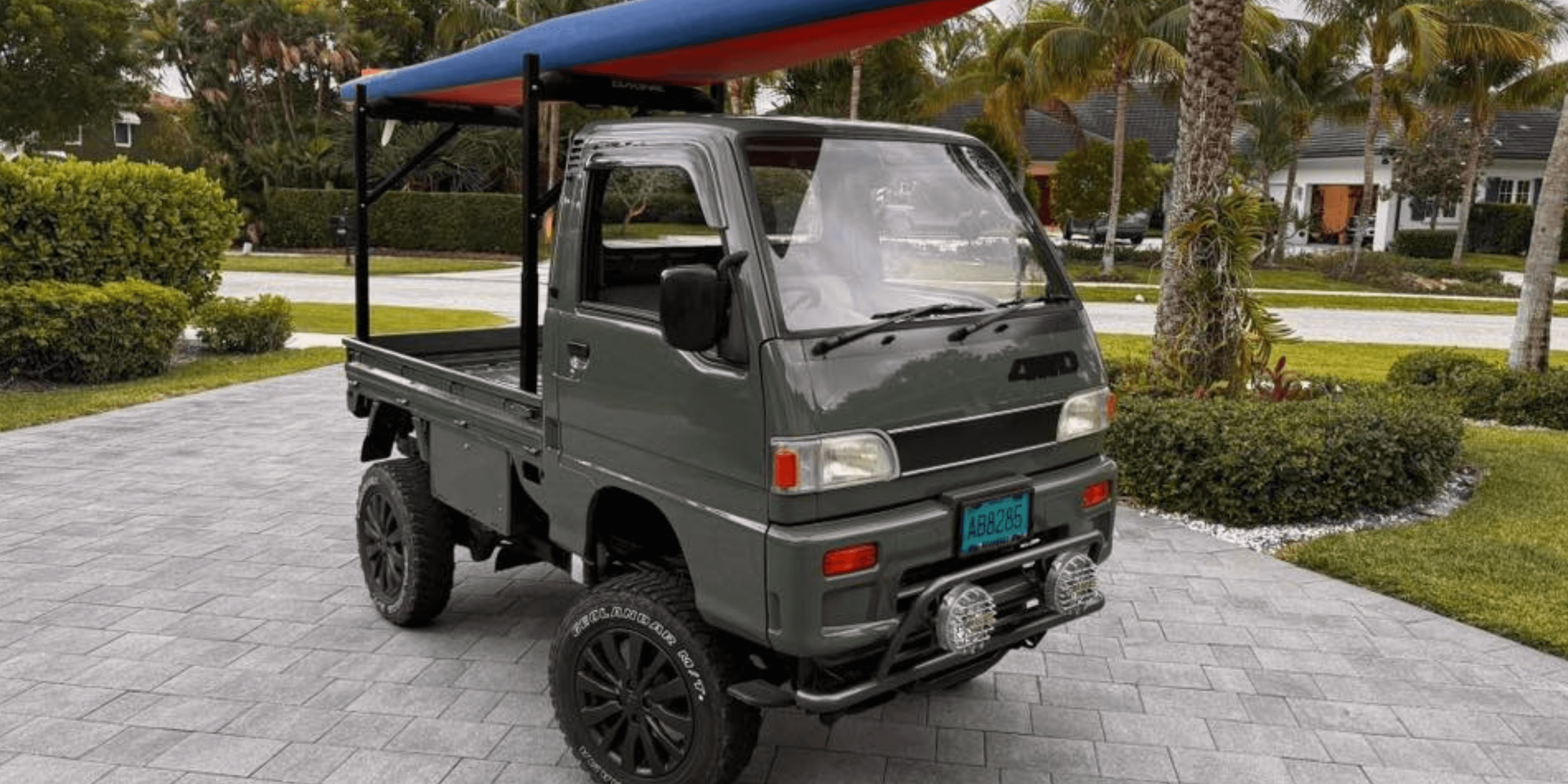
Quick Impact Summary: Kei Truck Lifts
- Clearance Gain: Average 1.5 to 2.5 inches of effective frame clearance.
- Geometry Shift: Caster typically drops 1-3 degrees per 2-inch lift.
- Tire Longevity: Expect 10-25% faster wear without camber correction.
- Performance: Approach angles improve to 28-35 degrees; highway stability decreases due to a higher center of gravity.
How Do Lift Kits Change Kei Truck Steering & Handling?
It’s vital to understand that lift kits raise ground clearance by 2-6 inches, but alter suspension angles (such as caster, camber curve, and toe behavior) by roughly 1-4 degrees depending on lift height and suspension design.

Visualizing how lift kits disrupt standard Ackerman steering geometry.
A standard kei truck setup relies on Ackerman steering geometry, which makes your inside wheel turn sharper than the outside wheel when cornering. As a result, both tires roll smoothly without dragging to the side, a condition known as “scrub.”
Lifting a kei truck tilts the suspension arms, changing their length/angle. This can increase bump steer and alter toe and camber behavior through suspension travel. The result is a reduction in how well the steering geometry maintains smooth tire tracking.
Without corrections, you can expect tire wear to be 10-25% faster with altered camber. Off-road gains can increase approach angles into the 28 to 35 degree range depending on bumper geometry and tire size. Regarding on-road risk, there’s an increased chance of rollover without corrections from the raised center of gravity.

What Suspension Geometry Parts Wear Down First After a Lift?
Of the core angles lifts disrupt first, caster hits highway handling the hardest. Caster is the forward or backward tilt of the front steering axis (the imaginary line between upper and lower suspension pivots) when viewed from the side. It’s an essential component of front-end alignment impacting steering stability, return-to-center feel, and high-speed handling.

A drop in caster leads to "wandering" at speeds over 60 mph.
Kei trucks, such as the Suzuki Carry and Daihatsu Hijet, have 5-7 degree positive caster. Lifting affects control arm angles, which will affect effective caster, depending on the suspension system used. On average, caster may drop 1-3 degrees per 2-inch lift, resulting in highway wander. This leaves steering feeling loose and unstable at 60+ mph.
You’ll then find that your droop camber goes too negative. Droop camber occurs when the suspension extends toward full droop during situations like rock crawling or rut traversal, where tire contact consistency affects available grip.

Extreme camber leads to accelerated inner tire edge wear.
Camber as a general term refers to how much your tires tilt side-to-side when viewed from the front. A lift kit will make your tires lean inward too much, likely -3 to -4 degrees rather than -1 to -2 degrees. As a result, contact on the inside edge is reduced and the available traction is limited.
Comparison: Stock vs. 2-Inch Lifted Kei Truck
| Metric | Stock Specs | Lifted (Uncorrected) |
|---|---|---|
| Ground Clearance | 6 - 6.5 inches | 8 - 9 inches |
| Caster Angle | 5 - 7 Degrees | 2 - 4 Degrees |
| Approach Angle | 25 Degrees | 28 - 32 Degrees |
| Tire Wear Rate | Standard | 10-25% Faster |
Step 1: Installing a 2-inch Lift (Real World Example)
Before a lift, your typical 6-6.5 kei truck clearance leaves you high-centered and more susceptible to front bumper scrapes. A 2-inch Oiwa Garage lift will add 1.5-2.5 inches of effective clearance at the frame for rocks/mud. While the exact approach angle gain depends on bumper geometry and wheelbase, you can expect the angle to jump from 25 degrees to 28-32 degrees on average. This progression would be standard for models like the Honda Acty, Suzuki Carry, and Daihatsu Hijet.
Stock tires in the ~22 to 24 inch range may still be used, but you’ll likely want to move into 24 to 26 inch territory and switch to all-terrain tires. Kei truck all-terrain tires grip rocks/ledges better than street tires, and the taller sidewall flexes over obstacles, preventing pinch flats. Additionally, stiffer tread blocks in all-terrain tires maintain shape when crawling vs. soft highway rubber, and you’re less likely to sink in soft terrain. Still, all-terrain tires remain quiet enough for daily use, and adding a 2-inch lift kit will only moderately drop fuel economy around 1-3 MPG (more often at the low end of this spectrum).

Step 2: How Does a Lifted Kei Truck Handle on the Highway?
The trail wins you experience with a kei truck lift kit are noticeable, but a highway test drive reveals geometry trade-offs. At highway speeds over 60 mph, steering feel becomes more sensitive, requiring consistent, small corrections. Reduced caster undermines the self-centering force that naturally straightens your wheel after turns. At the same time, toe curves (how wheel toe changes as the suspension moves up and down through its travel) alter under load. Subsequently, steering feels unnaturally light and twitchy, even in calm conditions.
Highway sensitivity is the first warning sign, followed by crosswind and rut sensitivity. Your kei truck’s narrow width, combined with a higher center of gravity, creates increased sensitivity to crosswinds and road ruts. Lifted Kei trucks demand alignment precision to prevent tire wear/instability, and instances like highway pulling can worsen over time without correction. Consistency in steering normally deteriorates before problems with alignment and wear become evident.
Step 3: Are Lifted Kei Trucks Street Legal in the US?
Before committing to a lift setup, verify its legality and compliance with U.S. state-specific vehicle modification laws. Kei trucks fall into different registration categories depending on import classification (25-year exemption), title status (road-legal vs. off-road), and intended road use. A wrong classification can result in impounding and fines.
Most states don't ban lifts outright. Instead, they regulate through safety compliance. For example, strict inspection states focus on areas like headlights aiming correctly (not skyward), bumpers staying within height ranges (typically 16 to 30 inches off ground), and tires remaining covered by fenders. Many states also enforce tire coverage laws requiring tread to be covered by fenders or flares, especially when upgrading to wider all-terrain tires after a lift. A 2-inch lift usually passes tests easily.
Enforcement typically hinges on written law, inspection discretion, local enforcement practices, and whether the truck is driven on-road or limited to off-road use.
Your three-step compliance sequence should include:
- Confirming vehicle classification (25-year import? Off-road title?)
- Reviewing state mod/inspection rules
- Verifying lighting/bumper/safety equipment before road use

Step 4: Budget Breakdown for Kei Truck Lift Kits
By now, you’ve probably realized that lift kits cost more than their sticker price. Spacer lifts, ranging from $200 to $600, provide only height, while full-suspension kit prices (with partial geometry correction components) can range from $1,000 to over $6,000. In other words, entry-level kits are relatively inexpensive but still require proper alignment and supporting components to avoid accelerated tire and steering wear.
For example, our 36-piece rear suspension kit for HA3 and HA4 Honda Actys includes rear shackle bushings and shock components. Other Acty drivers might benefit from a 33-piece front/rear suspension upgrade kit or a 10 to 41-piece steering and suspension upgrade kit.

Step 5: How to Correct Suspension Geometry After Lifting
Proper correction after lifting restores predictable steering behavior and helps reduce long-term tire wear. Geometry correction focuses on restoring caster, camber, and toe stability under load. Without these fixes, your highway wander and tire cupping can worsen over time.
In cases where adjustable parts are available, alignment adjustments may help restore the caster that was lost and improve steering stability. Oiwa Garage’s 2-inch Body Lift Kit for Honda Acty HA3 and HA4 models provides additional height without significantly altering suspension geometry.
Post-install 4-wheel alignment is critical, as toe misalignment can cause feathering and cupping, while camber errors accelerate edge wear.
Frequently Asked Questions
Why does my Kei truck steering feel light after a lift?
Lifting the vehicle typically reduces the positive caster angle by 1-3 degrees. This reduces the self-centering force of the steering wheel, making the truck feel "twitchy" or sensitive at highway speeds.
Will a 2-inch lift cause my tires to wear out faster?
Without alignment correction, expect tires to wear 10-25% faster. This is primarily due to negative camber and toe misalignment caused by the altered angle of the suspension control arms.